
There was a time when ranking #1 on Google was the ultimate goal.
But in 2026, it's not enough.
More than 60% of search interactions now involve some form of AI-generated answer. When someone asks ChatGPT for a product recommendation, searches on Perplexity for a comparison, or gets a Google AI Overview before they ever see the blue links, your traditional rank tracking tool has no idea what happened. This easily means that you could be sitting in SERP position one and still be losing traffic because an AI overview answered the query before anyone scrolled down.
Here's the tricky part: Google Search Console doesn't distinguish between AI Mode traffic and regular search traffic. So you genuinely can't tell whether AI is helping or hurting your brand without dedicated AI visibility rank tracking tools.
At AI Creator, we spent the last several weeks testing 15 of the best AI rank tracking tools across real prompts on ChatGPT, Perplexity, Google AI Overviews, Gemini, and Claude. Based on our findings, we have prepared this comprehensive listicle guide for you.
Whether you're a solo marketer, an agency managing clients, or an enterprise team building an AI visibility strategy from scratch, this guide will give a comprehensive idea of:
- What each AI rank tracker does well
- Where it falls short
- What it costs
- And, who it's actually built for.
TL;DR: the best AI rank tracking tools ranked
Here's how we'd rank the 15 AI visibility rank tracking tools we tested, from our top pick to the most niche option:
- SE Ranking (SE Visible): Best all-in-one tracker for teams that want traditional SEO and AI tracking in one dashboard
- Semrush (AI Visibility Index): Best for comprehensive market intelligence and enterprise brands
- Nightwatch: Best for combining local SEO with AI visibility tracking
- Peec AI: Best standalone AI tracker for agencies on a mid-range budget
- Ahrefs (Brand Radar): Best for teams already deep in the Ahrefs ecosystem
- AccuRanker (AccuLLM): Best for speed and on-demand rank checks
- Surfer AI Tracker: Best for content teams already using Surfer for optimization
- Rankscale AI: Best affordable entry point for AI tracking
- Otterly AI: Best budget-friendly cross-engine brand monitoring
- Keyword.com: Best credit-based flexible option for mixed workflows
- Scrunch AI: Best for brand safety and misinformation detection
- Profound AI: Best for enterprise-scale answer engine optimization
- AIclicks: Best for Google AI Mode-specific tracking
- Mangools AI Search Watcher: Best for solopreneurs and freelancers
- AI Rank Checker: Best pay-as-you-go option for occasional checks
Quick comparison table
✋🏼Quick note: pricing and packages are susceptible to updates. Hence, we request you to double-check before making any decision!
The 15 best AI visibility rank tracking tools in 2026
1. SE Ranking (SE Visible)
SE Ranking has quietly evolved into one of the most complete SEO platforms with AI tracking built into the core experience. Their SE Visible product tracks your brand across Google AI Overviews, AI Mode, ChatGPT, Gemini, and Perplexity, alongside showing traditional keyword rankings in a comprehensive dashboard. For teams that don't want to juggle separate tools for traditional SEO and AI visibility, SE Ranking is the perfect choice. Seeing how the platform tracks 37+ SERP features, supports keyword grouping and tagging, stores cached SERPs, and integrates with Google Analytics, Google Search Console, and Looker Studio, we decided to rank it no.1 on our list.
Feature highlights:
- Tracks AI visibility alongside traditional Google and Bing rankings in one unified dashboard with no context switching.
- Covers Google AI Overviews, AI Mode, ChatGPT, Gemini, and Perplexity from a single tracking setup.
- Full SEO suite included: keyword research, competitor analysis, backlink monitoring, and content tools.
- Share of voice metrics updated to account for AI citations alongside traditional blue link rankings.
Pricing:
- The base SEO platform starts at ~$65/month for 500 keywords with unlimited user seats.
- SE Visible, the AI tracking layer, starts at $119/month for 500 prompts and 5 brands with 10 day free trial and unlimited user seats.
- Higher tiers go up to $519/month for 1,500 prompts and 15 brands with unlimited user seats.
.webp)
2. Semrush (AI Visibility Index)
Semrush is the tool most digital marketers already know, and their expansion into AI visibility tracking has been substantial. The AI Visibility Index tracks brand mentions across ChatGPT, Gemini, and Perplexity, while the updated Share of Voice metric now factors in "pixels occupied" on the SERP rather than just ordinal position. This gives you a more honest picture of how much screen real estate your brand actually owns when AI Overviews, ads, and other features push organic results further down the page.
Feature highlights:
- AI Visibility Index monitors brand presence across ChatGPT, Gemini, and Perplexity
- Share of Voice 2.0 measures actual pixel depth and screen real estate, not just ranking position
- Cannibalization risk alerts that flag when AI Overviews might be stealing clicks from your top pages
- Competitor benchmarking across both traditional search and AI-generated answers with 110B+ keyword database
Pricing:
- Pro plans start at ~$140/month; Business and Enterprise tiers with the full AI toolkit cost significantly more.
- The AI Visibility Index is included in higher-tier subscriptions.
.webp)
3. Nightwatch
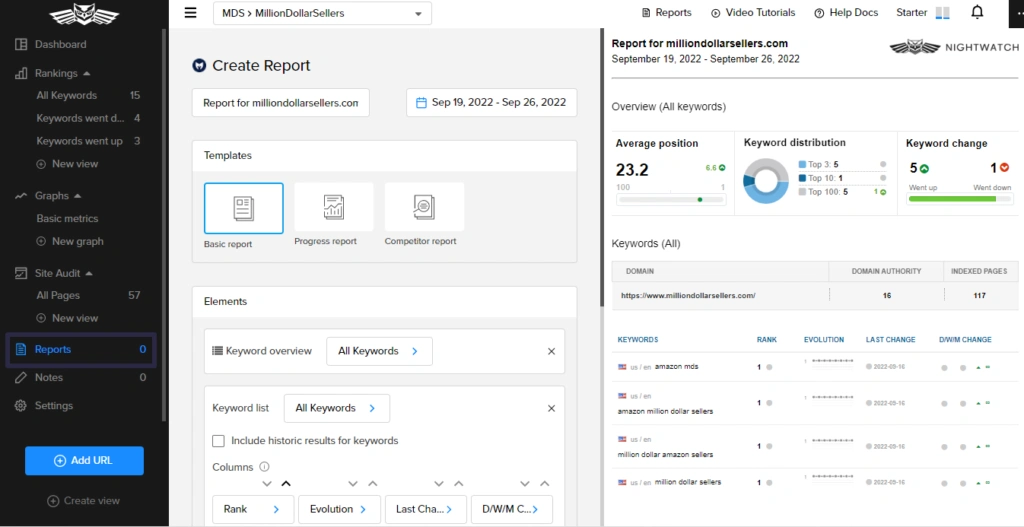
Nightwatch has long been a favorite for precise local rank tracking, and they've carried that strength into AI visibility. What makes Nightwatch unique is the combination of geo-grid local tracking (measuring visibility from specific GPS coordinates across 107,000+ locations) with generative AI ranking data from ChatGPT and Claude. For any business with physical locations or any agency managing local clients, this hybrid approach fills a gap that other tools simply don't address. Their data comes from actual Google data centers rather than approximations, which means the accuracy for local queries is notably higher than tools that rely on proxied or estimated location data.
Feature highlights:
- Generative Rankings track your specific position within AI-generated answers across LLMs.
- AI Visibility Score provides a composite measurement of brand presence in AI responses.
- Active Citations identify exactly which URLs AI engines reference when mentioning your brand.
- Geo-grid local tracking across 107,000+ locations with zip-code level precision.
Pricing:
- Plans start at approximately $79/month.
- Enterprise packages are available for agencies managing large client portfolios with multiple locations.
4. Peec AI
Peec AI is a dedicated AI visibility tracker that uses UI scraping to mirror what real users actually see when they interact with ChatGPT, Perplexity, Google AI Overviews, Gemini, and Claude. That methodology choice matters because API-based tools can sometimes return different results than what shows up in the actual user interface. Because of the comprehensive features and comparatively affordable pricing, we decided to rank it no.4.
Feature highlights:
- UI scraping methodology providing data that closely mirrors what real users actually see in AI responses
- Real-time alerts triggered when your brand's AI visibility shifts significantly
- Coverage across ChatGPT, Perplexity, Google AI Overviews, Gemini, and Claude from a single dashboard
- Built-in GEO audit features that diagnose why you're not being cited and suggest specific fixes
Pricing:
- Plans start at approximately $40/month.
.webp)
5. Ahrefs (Brand Radar)
Ahrefs remains the gold standard for backlink and SEO analysis, and Brand Radar extends that strength into AI visibility. It tracks your brand inside ChatGPT, Gemini, and Microsoft Copilot alongside Ahrefs' massive keyword and link database. During our tests, we realized that the real value is diagnostic, i.e., when rankings look stable, but traffic is dropping, Brand Radar reveals whether AI Overviews are absorbing clicks before users reach your link.
Feature highlights:
- Tracks AI share of voice and citations alongside the most trusted backlink database in SEO.
- Brand visibility monitoring inside ChatGPT, Gemini, and Microsoft Copilot.
- 110B+ keyword database providing context on why AI might be pulling specific sources over others.
- Seamless Looker Studio and Google Search Console integrations for straightforward client reporting.
Pricing:
- Brand Radar is included with all Ahrefs subscriptions, with no separate cost.
- Lite plan starts at ~$129/month, Standard at ~$249/month.
- Higher tiers unlock more extensive AI tracking and reporting.
.webp)
6. AccuRanker (AccuLLM)
AccuRanker is well-known for its speedy analysis, and AccuLLM brings that same philosophy to AI visibility. Unlike tools that update weekly or daily, AccuRanker lets you trigger on-demand rank checks whenever you need them. In our testing, the real-time refresh felt like a genuine advantage for monitoring campaign launches and competitive shifts as they happened.
Feature highlights:
- On-demand rank updates with no waiting for scheduled crawl cycles.
- Share of voice measurement spans both traditional search and AI-generated results.
- Coverage of ChatGPT, Perplexity, Google AI Overviews, and Gemini.
- Unlimited refresh frequency for real-time campaign monitoring and competitor watching.
Pricing:
- Plans start at ~$129/month, scaling with keyword volume.
- Higher tiers unlock more keywords and advanced reporting features.
.webp)
7. Surfer SEO AI Tracker
Surfer SEO's AI Tracker connects content creation directly to AI citation results within the same workflow. You can easily write and optimize in Surfer's editor, then track whether that content earns mentions in ChatGPT, Perplexity, and Google AI Overviews. The source transparency feature is particularly useful, identifying the exact URL feeding each AI answer so you know which assets to strengthen.
Feature highlights:
- Prompt-level monitoring reveals which specific questions trigger your brand to appear in AI answers.
- Source transparency identifies the exact URL that feeds each AI citation.
- Weekly trend reports tracking how your AI visibility changes over time.
- Direct integration into the Surfer content optimization workflow for a seamless creation-to-tracking loop.
Pricing:
- AI Tracker starts at ~$95/month for 25-prompt blocks.
- Added on top of existing Surfer SEO subscription costs.
- Volume discounts are available at higher prompt tiers.
.avif)
8. Rankscale AI
Rankscale offers the widest AI engine coverage at the lowest price point we found. At ~$20/month, it tracks ChatGPT, Perplexity, Google AI Overviews, AI Mode, Claude, and Copilot. Independent testing by Coalition Technologies reported near 100% accuracy on mention and citation detection across approximately 2,700 prompt pulls, which is remarkable for the price.
Feature highlights:
- Covers 6+ AI engines, including ChatGPT, Perplexity, Google AI Overviews, AI Mode, Claude, and Copilot.
- Competitive analysis and prompt-based testing are included even at the entry-level tier.
- A credit-based pricing system that makes costs easy to predict and model in advance.
- Near 100% mention and citation detection accuracy validated by independent agency testing.
Pricing:
- Starter plans begin at ~$20/month.
- Enterprise plan at $780/month for 12,000 credits.
.webp)
9. Otterly AI
Otterly makes AI visibility tracking accessible for small businesses and solo marketers who aren't ready for enterprise pricing. At ~$29/month, it covers ChatGPT, Perplexity, Google, and Gemini with built-in GEO audits that explain why you're invisible and suggest specific fixes. The simple interface means you don't need to be an SEO specialist to set it up and act on the data.
Feature highlights:
- Cross-engine brand monitoring covering ChatGPT, Perplexity, Google, and Gemini.
- Built-in GEO audit features with actionable recommendations for improving AI visibility.
- Competitor tracking showing how your AI presence stacks up against rivals.
- Clean, simple interface designed for people who aren't deep SEO specialists.
Pricing:
- Plans start at ~$29/month with straightforward monthly billing.
- Higher tiers available for agencies managing multiple brands.
- All plans include GEO audit and competitor tracking features.
.webp)
10. Keyword.com
Keyword.com adds AI visibility as a flexible, credit-based layer on top of its traditional rank tracking platform. Ideal for teams with variable tracking needs, you only pay for the AI checks you actually run each month. The API-first design makes it particularly useful for technical teams piping data into Looker Studio, Tableau, or custom dashboards.
Feature highlights:
- Credit-based AI tracking system that flexes with your actual usage each month.
- Citation and sentiment monitoring across ChatGPT, Gemini, Claude, and Perplexity.
- API-first design built for integration with Looker Studio, Tableau, and custom reporting tools.
- Traditional rank tracking is included as the base product, so you get both in one subscription.
Pricing:
- Base platform starts at ~$26/month for traditional rank tracking.
- AI tracking credits are purchased separately as an add-on.
.webp)
11. Scrunch AI
Scrunch AI focuses on what AI is saying about you, not just whether you're mentioned. Its misinformation detection flags when AI engines state incorrect facts, outdated stats, or misleading competitor comparisons. We found this tool to be particularly valuable for brands in regulated industries like healthcare and finance, where AI hallucinations carry real reputational risk.
Feature highlights:
- Misinformation detection that flags when AI engines state incorrect facts about your brand.
- Brand safety monitoring across ChatGPT, Claude, and Gemini for narrative accuracy.
- Technical AI optimization recommendations for improving how AI bots read and interpret your site.
- Competitor benchmarking focused on narrative quality and sentiment rather than just mention volume.
Pricing:
- Custom pricing based on brand size and monitoring scope.
.webp)
12. Profound AI
Profound tracks visibility across 10+ LLMs, the widest coverage we've encountered, and is built for enterprise teams treating AI search as a strategic channel. Its unique prompt volume data estimates how many people are actually asking AI the questions you're targeting, which is invaluable for prioritizing content investments at scale.
Feature highlights:
- Visibility tracking across 10+ LLMs, the widest AI engine coverage available
- Prompt volume data estimating real search demand for AI-specific queries
- Enterprise-grade reporting with deep business intelligence platform integrations
- Purpose-built for answer engine optimization strategy at organizational scale
Pricing:
- Plans start at ~$499/month.
.webp)
13. AIclicks
AIclicks goes deep where others go wide, focusing specifically on Google AI Mode and AI Overviews with more granular data than generalist tools offer. This tool is best suited for teams whose primary concern is how Google's AI layer treats their brand.
Feature highlights:
- Prompt-level tracking specifically optimized for Google AI Mode and AI Overviews.
- Secondary coverage of ChatGPT and Perplexity for cross-engine comparison.
- Dashboard visualization designed around tracking AI referral conversion patterns.
- Free trial available to test the platform with your own brand and real prompts.
Pricing:
- Custom pricing based on prompt volume and tracking needs.
- Free trial available to test with your own brand.
.avif)
14. Mangools AI Search Watcher
Mangools AI Search Watcher is the easiest on-ramp into AI visibility tracking. It auto-suggests relevant prompts, provides competitor comparisons with sentiment analysis, and sets up in about 30 seconds. Perfect for freelance SEOs, solo marketers, and small business owners who want AI tracking without a learning curve or serious budget commitment.
Feature highlights:
- Auto-generated prompt suggestions based on your brand, removing the need to build prompt libraries manually.
- Side-by-side competitor comparison reports across all covered AI engines.
- Sentiment and brand perception analysis showing how AI platforms interpret and describe your brand.
- 30-second setup process with minimal configuration required.
Pricing:
- Included with Mangools plans starting at ~$19/month.
- Higher tiers available for teams and agencies.
.webp)
15. AI Rank Checker
AI Rank Checker ditches monthly subscriptions entirely for a wallet-based pay-as-you-go model starting at $0.027 per check. This platform is ideal for consultants running periodic audits or teams that need occasional snapshots rather than continuous monitoring. Engine coverage is among the widest available, including ChatGPT, Perplexity, Claude, Gemini, Copilot, and Grok.
Feature highlights:
- Pay-as-you-go wallet system starting from $0.027 per check with no monthly subscription required.
- Covers ChatGPT, Perplexity, Claude, Gemini, Copilot, and Grok, one of the widest coverage options available.
- Multi-domain tracking with separate dashboards makes it practical for agencies running audits.
- Downloadable reports for clean client or stakeholder presentations.
Pricing:
- Pay per check starting from $0.027 each.
- Unused credits remain valid for five years.
.webp)
How we tested and ranked these AI visibility tools
We know there's healthy skepticism in the SEO community about AI rank trackers. Tim Soulo, the CMO of Ahrefs, made waves arguing that many AI search rank trackers generate artificial prompt lists rather than tracking real user behavior. He's not entirely wrong, and we think it's worth addressing directly.
Are AI rank tracking tools perfectly accurate? No. Large language models are inherently variable. You can run the same prompt twice and get different sources cited each time. Any tool that claims 100% accuracy across every AI engine is overselling. But the best tools use repeat sampling, transparent data collection methods, and consistent methodologies to give you reliable directional data.
So the question isn't "is this perfectly precise?" but "does this help me understand and improve my AI visibility over time?" For the best tools on this list, the answer is yes.
Here's what we evaluated each tool on:
- AI engine coverage: How many platforms does it track? We treated ChatGPT, Perplexity, Google AI Overviews, Gemini, and Claude as the baseline. Extra points for covering Copilot, Grok, and others.
- Data accuracy and methodology: UI scraping versus API pulls? How transparent is the company about how they collect and verify data?
- Actionability: Can you use the data to actually improve your visibility, or is it just a dashboard showing numbers with no next steps?
- Pricing and value: What do you get for what you pay? Does the pricing model make sense for the team size it's aimed at?
- Ease of use: How fast can you set it up and start getting useful insights?
- Scalability: Does it work for a single brand, or can it handle agencies managing dozens of clients?
Free AI rank tracking tools worth trying
But before committing to a paid AI visibility tool, you should check out the following tools to get a quick baseline read on your brand's AI presence for free. While these won't replace a proper ongoing tracking setup, they're genuinely useful for initial audits, quick sanity checks, and understanding whether AI tracking should be a priority for your brand.
- Am I On AI: Gives you an instant check on whether your brand appears in major AI answers. Zero setup, zero cost. Good for a first look.
- ZipTie.dev: Goes a step further with actionable optimization tips plus actual screenshots of Google AI Overviews for your target queries. Useful for seeing exactly what users experience.
- HubSpot AEO Grader: Provides a free AI readiness assessment for your website, scoring how well your content is structured for AI citation.
- Lpagery ChatGPT Rank Tracker: Generates up to 50 relevant prompts and tests them live against ChatGPT, showing whether your brand gets mentioned, in what position, and for which queries. Completely free with no account required.
- Ekamoira Page Citability Analyzer: Evaluates how "citable" individual pages on your site are for AI engines, identifying structural issues that might prevent AI from using your content as a source.
- SEO.com AI Overviews Checker: Gives you three free checks per day to see whether you appear in Google's AI Overviews for specific queries.

We have talked about a lot of AI tools in this guide so far. Want to know how to use them for content creation? Check out our vast tutorial library.
What is an AI visibility rank tracking tool?
An AI visibility rank tracking tool monitors whether your brand, website, or product appears in AI-generated answers across platforms like ChatGPT, Google AI Overviews, Perplexity, Gemini, and Claude.
That might sound similar to traditional rank tracking tools, but these work differently. A traditional rank tracker checks your position in a list of ten blue links. However, an AI rank tracker measures something else entirely: whether you're mentioned at all when someone asks an AI a question related to your industry.
The key metrics these tools track include:
- Brand mentions (is your name showing up in AI answers?)
- Citations (is the AI actually linking back to your URL as a source?)
- Share of voice (how often do you appear compared to competitors for the same prompts?)
- And, sentiment (is the AI recommending you positively or just mentioning you neutrally, or worse, inaccurately?).
Most of these tools collect data in one of two ways. Some use UI scraping, which means they interact with the AI interface the same way a real user would and capture the actual response. Others use the AI platform's API, which can sometimes return slightly different results than what a user would see. This distinction matters, and we've flagged the methodology for each tool where we know it.
If someone asks ChatGPT, "What's the best project management tool for startups?" and your product doesn't show up in the response, a traditional rank tracker would never tell you. But an AI visibility tracker will.
Why you need an AI rank tracker in 2026
The case for AI rank tracking isn't theoretical anymore. Here are some of the pressing reasons why you need an AI rank tracker in 2026:
AI Overviews are stealing your clicks
Industry research shows that Google AI Overviews reduced click-through rates by 34% or more on queries where they appear. When an AI-generated summary answers the question fully at the top of the page, most users never scroll to the traditional results below. Your "position 1" ranking might be sitting 1,200 pixels down the page, well below the fold. This is why pixel rank tracking has become a prime concept in 2026.
People are searching on ChatGPT instead of Google
Millions of users now go straight to Claude, ChatGPT, Perplexity, or Gemini for buying advice, research, and product recommendations. If your brand doesn't appear in those AI-generated responses, you're invisible to an entire audience that never even reaches a search engine results page.
Google Search Console can't help you here
Google has confirmed that AI Mode data is counted within Search Console, but it's not segmented separately. This means that you can't distinguish AI-driven impressions from traditional search impressions using GSC alone.
Most budget rank trackers broke in late 2025
When Google disabled the num=100 search parameter, many budget rank trackers lost accuracy overnight. This event, also called the "great decoupling," meant that tools without a verified data infrastructure became unreliable for traditional tracking, too. The tools that survived and adapted are the ones worth paying attention to now.
Your competitors might already be tracking this
Over $31 million in venture capital has flowed into AI visibility tracking tools in the last two years. This isn't an experimental category anymore. If competitors in your space are optimizing for AI citations and you're not even measuring your AI presence, you're already behind.
Ranking #1 doesn't mean what it used to
It's no longer about ranking highest in a list of links. It's about being the source that AI engines trust enough to cite when they generate an answer. That requires fundamentally different tracking than what traditional SEO tools provide.
How to make the most out of your AI visibility rank tracker
Here's how to turn tracking data into actual visibility improvements:
Make your content easy for AI to cite
AI models prefer content that's structured clearly and delivers answers upfront. Start sections with direct, factual statements rather than building up to conclusions. Use comparison tables, clear headings, and organized data that AI can easily extract and reference. Keep your HTML clean, and avoid heavy JavaScript that hides content from crawlers. Some teams are now adding an llms.txt file to their site, which gives AI bots a structured, machine-readable summary of what your site offers. Schema markup and structured data also help reduce the guesswork for AI crawlers trying to understand your content.
Build authority where AI already looks
This is something many teams miss. AI models don't just read your website in isolation. They heavily reference sources such as Reddit threads, G2 reviews, Capterra listings, industry directories, and community forum discussions. Active and authentic participation in these places is a genuine ranking signal for AI inclusion. If someone asks a question on Reddit about tools in your category and you're not part of that conversation, you're missing a citation opportunity that AI models will pick up on. Keep your directory profiles and review platforms always updated.
Don't block the bots that matter
Check your robots.txt file to make sure you're not accidentally blocking GPTBot, PerplexityBot, ClaudeBot, or other AI crawlers. If your site relies heavily on client-side JavaScript rendering, consider server-side rendering for your most important pages so that AI bots can actually read the content without executing scripts. The "dual web" approach, serving a clean, fact-dense version of your pages to AI bots while keeping the visual experience for human visitors, is gaining traction among content-heavy sites.
Monitor weekly and iterate based on what you find
Besides these tools, use GA4 segments and Posthog to track AI referral traffic patterns. When you notice a competitor gaining citations in an area where you're absent, analyze their content to understand what they're providing that you aren't. Combine your tracking data with proactive outreach to get your brand added to lists, directories, and resource pages that AI models already reference. The brands that treat AI visibility as an ongoing practice rather than a one-time optimization consistently outperform those that don't.
Success story: How HubSpot engineered its AI visibility (and what Chegg lost by ignoring it)
HubSpot was long considered the gold standard of SEO, attracting over 13 million monthly organic visits. Then Google's 2024 algorithm updates penalized their broad content strategy — articles about shrug emojis, resignation letters, and famous quotes that had nothing to do with CRM. Traffic dropped to under 7 million in weeks, an 80% decline.
Instead of trying to reclaim those lost informational keywords, HubSpot pivoted: they pruned irrelevant content, doubled down on topical authority around their core product, and optimized for AI citations. Today, HubSpot commands a 35.3% share of voice in AI-generated CRM responses and reports being cited more than any other CRM in LLMs.
On the flip side, Chegg ignored AI search entirely and lost 99% of its market value when ChatGPT started answering for free what Chegg charged for.
Letting you in on a small secret: one single tool cannot bring you all that SEO success. You need a comprehensive stack that will optimize your current SEO efforts on an end-to-end basis. If you’re looking to add an AI SEO tool to your setup, check out this blog featuring our top AI SEO tool recommendations: both free and paid.
Final thoughts
No single AI visibility rank tracking tool covers every need. The right choice depends on your budget, team size, and what matters most to your brand's growth right now.
If you want everything in one place, SE Ranking or Semrush will serve you well. If you're an agency looking for dedicated AI tracking without enterprise pricing, Peec AI is the sweet spot. For budget-conscious teams, Rankscale AI and Otterly AI deliver real value at accessible price points. And if you just want a quick check before committing to anything, the free tools and AI Rank Checker's pay-as-you-go model let you test the waters without risk.
{{cta}}
FAQ
What is an AI rank tracking tool?
An AI rank tracking tool monitors whether your brand appears in AI-generated answers from platforms like ChatGPT, Google AI Overviews, Perplexity, Gemini, and Claude. Unlike traditional rank trackers that check your position in a list of search result links, AI trackers measure mentions, citations, share of voice, and sentiment within AI responses.
How do AI rank trackers differ from traditional SEO rank trackers?
Traditional rank trackers tell you where your website sits in a list of ten blue links on Google. AI rank trackers measure something fundamentally different: whether your brand is mentioned, cited, or recommended when an AI engine generates an answer. There's no "position 3" in a ChatGPT response. Instead, you're either cited as a source, mentioned in the narrative, or absent entirely.
Are AI rank tracking tools accurate?
They provide reliable directional data, but they're not perfectly precise. Large language models are inherently variable, meaning the same prompt can generate slightly different responses each time. Good tools account for this by using repeated sampling and transparent methodologies. The goal isn't surgical precision but understanding trends: are you becoming more visible or less visible over time?
Can you track your brand in ChatGPT?
Yes. Several tools on this list specifically track ChatGPT visibility, including SE Ranking, Peec AI, Rankscale AI, and others. They monitor whether ChatGPT mentions your brand, links to your site, and how your share of voice compares to competitors for relevant prompts.
Are there free AI rank tracking tools?
Yes. Tools like Am I On AI, ZipTie.dev, HubSpot AEO Grader, and Lpagery's ChatGPT Rank Tracker offer free AI visibility checks. They're useful for initial audits and quick snapshots, though they lack the continuous monitoring and depth of paid tools.
Do you still need traditional rank tracking in 2026?
Absolutely. Traditional organic rankings still drive significant traffic. But tracking them alone gives you an incomplete picture. The ideal setup in 2026 combines traditional rank tracking with AI visibility monitoring, either through an all-in-one tool like SE Ranking or Semrush, or by pairing a traditional tracker with a dedicated AI visibility tool.
What is AI share of voice?
AI share of voice measures how often your brand appears in AI-generated answers compared to your competitors for a given set of prompts or topics. If ChatGPT mentions your brand in 7 out of 10 relevant prompts and your competitor shows up in 3, your share of voice is higher. It's one of the most practical metrics for benchmarking AI visibility.
What is Google AI Mode and how does it affect rankings?
Google AI Mode is the conversational AI answer layer that appears in Google Search. Instead of showing just a list of links, Google generates an AI-written summary that cites a small number of sources. For many queries, this AI answer is the first and sometimes only thing users read. It can reduce clicks to traditional organic results by 34% or more, making it critical to track whether you're cited in these responses.
How do AI search engines decide which brands to cite?
AI models favor content that demonstrates clear expertise, is well-structured, and comes from authoritative, trustworthy sources. Strong E-E-A-T signals (experience, expertise, authoritativeness, trustworthiness), clean website architecture, active presence on trusted third-party platforms like Reddit and G2, quality backlink profiles, and schema markup all influence whether an AI engine cites your brand.
What is the cheapest AI rank tracking tool?
Mangools AI Search Watcher starts at approximately $19/month with a Mangools subscription. Rankscale AI starts at around $20/month. For pay-as-you-go usage, AI Rank Checker charges as little as $0.027 per check with no monthly commitment.
Can AI rank tracking tools help with local SEO?
Some can. Nightwatch is the strongest option for combining local SEO with AI visibility, offering geo-grid tracking across 107,000+ locations alongside AI ranking data. Most other AI tracking tools focus on national or global visibility rather than location-specific results.
What is prompt-level tracking?
Prompt-level tracking means monitoring your brand's visibility for specific conversational questions that users ask AI engines, rather than tracking broad keywords. For example, instead of tracking the keyword "CRM software," you'd track the prompt "What is the best CRM for startups?" This approach aligns with how people actually interact with AI platforms.
What is the difference between AEO and GEO?
AEO stands for Answer Engine Optimization, which is the practice of optimizing your content to be cited by AI platforms that provide direct answers. GEO stands for Generative Engine Optimization, which is a broader term covering optimization for any generative AI search experience. In practice, the terms are often used interchangeably, though GEO tends to emphasize the generative and conversational nature of the platforms.
How do you connect AI visibility to actual revenue?
The most practical approach combines AI tracking data with web analytics. Use GA4 segments to identify traffic arriving from AI referral sources. Tools like SE Ranking and Semrush integrate with Google Analytics and Looker Studio, allowing you to correlate AI visibility changes with traffic, leads, and conversions. Some enterprise tools also support BigQuery integration for building custom revenue attribution models.
Should you block or allow AI bots to crawl your site?
In most cases, you should allow them. Blocking GPTBot, PerplexityBot, or other AI crawlers means those platforms can't index your content, which makes it much harder to earn citations in their responses. Check your robots.txt file to confirm these bots aren't blocked. Use server-side rendering for important pages to ensure AI crawlers can read your content even if it relies on JavaScript.
.png)